For some vehicle owners, a factory paint palette is not enough. They desire a colour that reflects their individuality—perhaps a favourite hue, a historical colour from a classic model or a shade that complements their personal style. Manufacturers respond with programmes that allow customers to select custom paint colours, often called paint‑to‑sample or bespoke paint programmes. While these custom colours add exclusivity, they also present challenges during collision repair. Matching a bespoke colour requires careful formulation, testing and application to ensure that the repaired area is indistinguishable from the original.
The bespoke paint process begins long before the vehicle is assembled. Customers work with the manufacturer’s design team to choose or create a colour. The chosen colour is formulated in the manufacturer’s paint lab, where chemists mix pigments to achieve the desired hue, saturation and finish. The resulting formula becomes part of the vehicle’s build information. When the vehicle is repaired, the repair facility must access this formula. Manufacturers may provide the formula to certified shops, or the repair facility may need to reverse‑engineer the colour using spectrophotometry.
Spectrophotometry is essential for analysing custom colours. A spectrophotometer measures the light reflected from the paint surface at multiple wavelengths, generating a unique signature. This signature helps technicians determine the base colour and the types of pigments used. However, paint‑to‑sample colours may include special effect pigments, such as mica flakes or colour‑shift particles, that interact with light differently. These effects can be difficult to quantify. Experienced technicians use the spectrophotometer as a starting point and then make manual adjustments to the formula, guided by visual comparison under different lighting conditions.
The choice of pigments influences not only the colour but also the paint’s behaviour. Some pigments are more translucent, meaning that underlying layers affect the final appearance. Others may be prone to clustering or orientation issues when sprayed, leading to variations in metallic flake distribution. To counter these challenges, technicians adjust the spraying technique. They may vary the distance between the spray gun and the panel, the air pressure or the number of coats applied. Consistency in technique is critical, as small differences can lead to visible shade variations across panels.
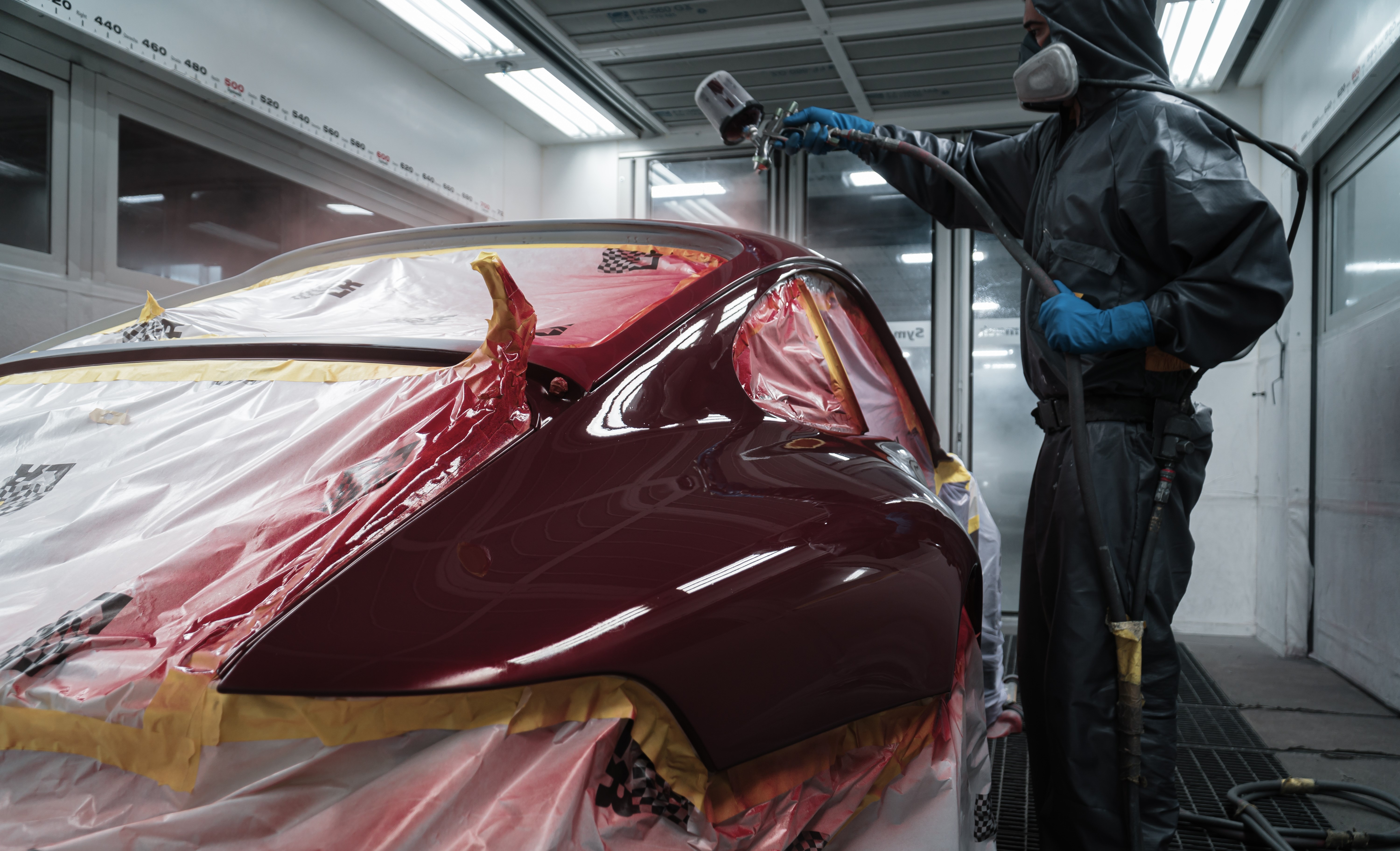
Environmental control is vital when applying bespoke colours. Temperature, humidity and airflow affect how paint dries and how pigments align. Many repair facilities invest in climate‑controlled spray booths that maintain ideal conditions and prevent dust contamination. For paint‑to‑sample colours, some technicians create test panels sprayed under the same conditions as the vehicle to evaluate the match. These panels are examined under daylight simulators, fluorescent lights and sunlight to ensure that the colour appears consistent across different environments.
Blending is often the key to seamless repair. Because matching a bespoke colour exactly is challenging, technicians blend the new paint into the surrounding area, gradually feathering the colour and clear coat. This technique creates a transition zone where the human eye cannot detect a difference. The size of the blend depends on the colour’s complexity and the vehicle’s shape. Larger panels or areas with complex curves may require more extensive blending. Clear coat is extended beyond the blend to ensure that the gloss and texture match.
After application, the paint must cure properly to achieve durability and gloss. Baking in an oven or using infrared curing accelerates this process. Once cured, the surface is polished to remove any minor imperfections and to enhance the depth of the colour. Polishing techniques vary depending on the finish; high‑gloss paints may require a finer compound and pad, while satin finishes need careful handling to avoid altering the sheen. Protective coatings, such as ceramic coatings or paint protection film, can be applied to preserve the custom colour and protect against environmental damage.
Documentation of the repair is important, especially for bespoke colours. The repair facility records the formula used, the blending techniques and the conditions under which the paint was applied. This information is valuable for future reference if additional repairs are needed. Owners may also appreciate having a record for their vehicle files, enhancing the provenance and value of a bespoke car.
Repair facilities that specialise in custom colours invest in equipment, training and processes that allow them to deliver results that honour the original vision of the vehicle owner and manufacturer.
.avif)